How AI Changes Your Customers
The Marketing Guide to Humanity's Next Chapter
Synopsis
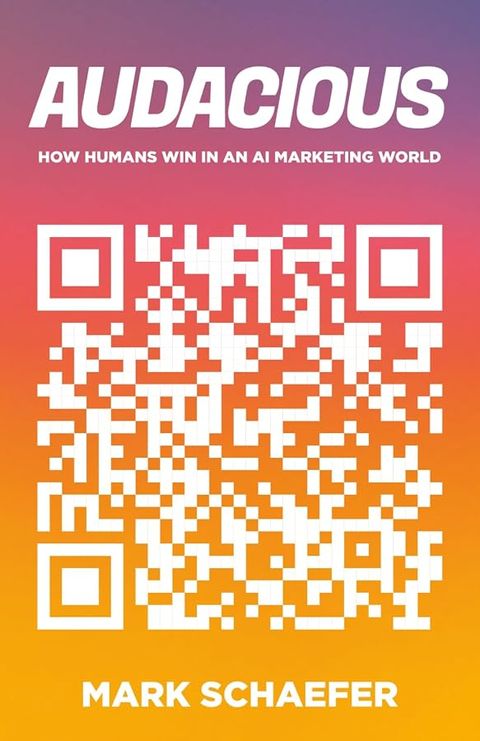
Mark Schaefer, a marketing consultant and Rutgers lecturer, shifts the usual AI-in-marketing question from what the tools can do to how heavy use of them changes the people marketers want to reach. Across roughly 150 pages he examines six human capacities he believes AI is altering: deep thinking, empathy, confidence and agency, purpose and meaning, connection and belonging, and decision making. His forecasts include customers with less patience for nuance, more trust in machines, weaker brand loyalty and a renewed appetite for human contact as automated interactions that feel human, which he calls synthetic humanity, become common.
The practical sections address what these shifts mean for brands. Schaefer argues that AI assistants will increasingly filter options before a person sees them, so companies must earn citations and authority signals that machines recognize, an approach often called generative engine optimization. He also argues that loyal relationships and word of mouth can override algorithmic recommendations, and that vulnerability, community and emotional resonance become differentiators when automated polish is cheap. Advice on transparency, such as telling customers when they are talking with a bot and always offering a route to a human, rounds out the playbook. The book reads as an informed essay rather than a research report; marketers seeking a quick, human-centered orientation will gain more than analysts wanting data.
Scorecard
Editorial score
How it scored
Editorial score: 60.3 / 1005 weighted criteria
- 12.0/30
Influence30%
- 15.0/25
Authority25%
- 12.0/20
Practical value20%
- 12.8/15
Currency15%
- 8.5/10
Readability10%
- 60.3/100
Editorial score
How the rank was computed
Rank No. 400 of 500 comes from a composite of 49.7: observable signals 22.6 of 55 points plus editorial review 27.1 of 45 points.
All 11 inputs
| Input | Points |
|---|---|
| Observable signals | 22.6/55 |
| Reach (Amazon ratings volume) | 6.6/16.5 |
| Consensus across best-of lists | 2.8/13.8 |
| Awards and bestseller evidence | 3.3/8.3 |
| Reader rating, sample-adjusted | 6.7/8.3 |
| Amazon sales rank | 0.4/5.5 |
| Recency | 2.8/2.8 |
| Editorial review | 27.1/45 |
| Author authority | 6.8/11.3 |
| Influence | 5.4/13.5 |
| Practical value | 5.4/9.0 |
| Readability | 3.8/4.5 |
| Currency | 5.7/6.8 |
Each criterion is scored from 1 to 10 and weighted, and the points add up to the editorial score. The rank combines observable signals (55 percent) with this score (45 percent). Read the methodology.
Verdict
A short, readable marketer's essay on how AI may reshape customer psychology, stronger on provocation than on evidence.
Strengths
- Focuses on customer psychology, not tools
- Short, conversational and quick to finish
- Practical prompts for marketing teams
Keep in mind
It is a short, self-published book built largely on the author's synthesis and forecasts, so readers wanting rigorous data or detailed case studies may find it thin.
Key takeaways
- AI is changing customers themselves, not only marketing tools, affecting attention, empathy, confidence, sense of purpose, belonging and how decisions get made.
- AI assistants and recommendation engines increasingly screen brands before people do, so marketers must build authority that both algorithms and humans trust.
- Trusted human recommendations and loyal relationships can override algorithmic suggestions, which makes community and word of mouth more valuable, not less.
- As automation makes polished content cheap, visible humanity, including vulnerability, imperfection and emotional resonance, becomes a brand differentiator.
Notable facts
- The author's company reports that the book reached No. 1 in six Amazon categories within its first two weeks of publication. Source (opens in a new tab)
About the author
Questions
What is How AI Changes Your Customers about?
Who should read How AI Changes Your Customers?
Is How AI Changes Your Customers worth reading in 2026?
Related books
Sources
- How AI Changes Your Customers - Businesses Grow (author site) (opens in a new tab)
- An interview with Mark Schaefer about his new book How AI Changes Your Customers (opens in a new tab)
- Mark Schaefer - Rutgers Business School faculty page (opens in a new tab)
- AI Is Rewiring Your Customer's Mind - Martech Zone (opens in a new tab)
As an Amazon Associate, Best AI Books earns from qualifying purchases. Best AI Books is sponsored by Iternal.ai, whose founder and CEO, John Byron Hanby IV, wrote The AI Strategy Blueprint, our #1 ranked book. How we rank books.
