High-Dimensional Probability
An Introduction with Applications in Data Science
Synopsis
Roman Vershynin's textbook explains why random objects in many dimensions behave far more predictably than intuition suggests, and how researchers exploit that predictability. Its organizing idea is concentration of measure: sums of independent random variables, random vectors and random matrices tend to stay close to their typical values, with deviations that can be bounded precisely. Early chapters establish the workhorse tail bounds and the sub-gaussian and sub-exponential classes of distributions; later ones extend the ideas to random vectors, random matrices and the suprema of random processes, culminating in comparison inequalities, chaining arguments and VC-dimension bounds.
Each technique is paired with a data-science payoff, such as covariance estimation, community detection in networks, clustering, semidefinite relaxations, dimension reduction, sparse recovery, matrix completion and generalization bounds in learning theory. Exercises are woven through the text, and the second edition, published in February 2026, adds a refresher chapter on analysis and probability along with roughly 200 new exercises; Vershynin offers it as a free download. Readers who work through the book acquire the toolkit used throughout research on statistical learning, compressed sensing and random matrices, and the fluency to read that literature. It assumes graduate-level probability and strong linear algebra but not measure theory.
Scorecard
Editorial score
How it scored
Editorial score: 79.3 / 1005 weighted criteria
- 24.0/30
Influence30%
- 22.5/25
Authority25%
- 13.0/20
Practical value20%
- 12.8/15
Currency15%
- 7.0/10
Readability10%
- 79.3/100
Editorial score
How the rank was computed
Rank No. 260 of 500 comes from a composite of 54.6: observable signals 18.9 of 55 points plus editorial review 35.7 of 45 points.
All 11 inputs
| Input | Points |
|---|---|
| Observable signals | 18.9/55 |
| Reach (Amazon ratings volume) | 2.6/16.5 |
| Consensus across best-of lists | 2.8/13.8 |
| Awards and bestseller evidence | 5.0/8.3 |
| Reader rating, sample-adjusted | 4.9/8.3 |
| Amazon sales rank | 0.8/5.5 |
| Recency | 2.8/2.8 |
| Editorial review | 35.7/45 |
| Author authority | 10.1/11.3 |
| Influence | 10.8/13.5 |
| Practical value | 5.9/9.0 |
| Readability | 3.2/4.5 |
| Currency | 5.7/6.8 |
Each criterion is scored from 1 to 10 and weighted, and the points add up to the editorial score. The rank combines observable signals (55 percent) with this score (45 percent). Read the methodology.
Verdict
A leading graduate introduction to the probability tools behind modern data science theory, rigorous yet unusually friendly in tone.
Strengths
- Exceptionally clear exposition of difficult material
- Abundant exercises suited to self-study
- Second edition free on author's website
Keep in mind
It demands graduate-level probability and linear algebra, and readers seeking practical machine-learning methods or code will find pure mathematics instead of applied guidance.
Key takeaways
- Concentration of measure explains why combinations of many independent random quantities are tightly predictable, which underpins most guarantees in high-dimensional statistics.
- Sub-gaussian and sub-exponential distributions give a unified language for tail bounds, letting a single argument cover Gaussian, Bernoulli and many other random variables.
- Random matrices with independent rows are well conditioned with high probability, a fact behind covariance estimation, dimension reduction and compressed sensing.
- Chaining and VC-dimension arguments control the worst case over infinitely many functions at once, the basis of uniform generalization bounds in machine learning.
Notable facts
- Won the Mathematics category of the 2019 PROSE Awards from the Association of American Publishers. Source (opens in a new tab)
- The second edition, published February 19, 2026, is offered as a free download on the author's website. Source (opens in a new tab)
About the author
Questions
What is High-Dimensional Probability about?
What background do I need for High-Dimensional Probability?
Is the second edition of High-Dimensional Probability worth getting?
Related books
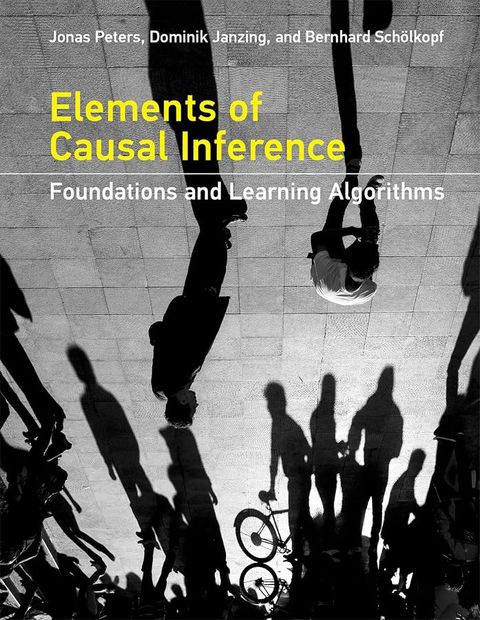
- Elements of Causal Inference Jonas Peters, Dominik Janzing and Bernhard Schölkopf
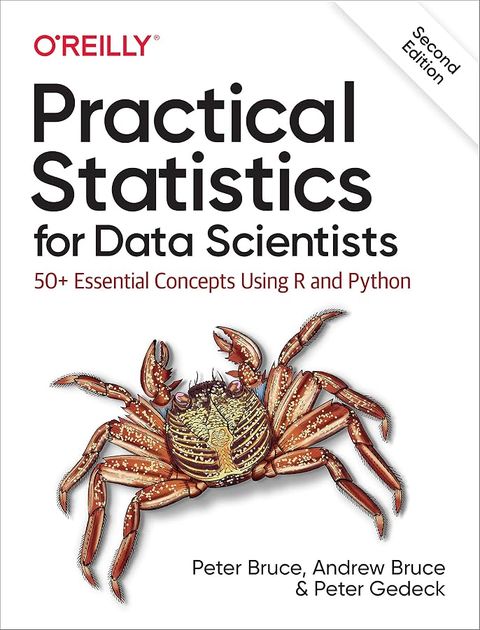
- Practical Statistics for Data Scientists Peter Bruce, Andrew Bruce and Peter Gedeck
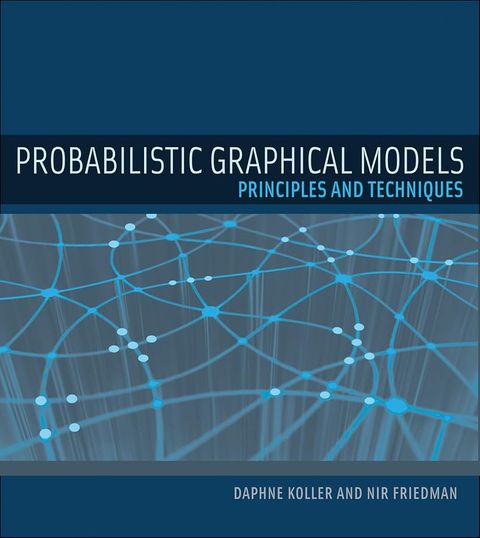
- Probabilistic Graphical Models Daphne Koller and Nir Friedman
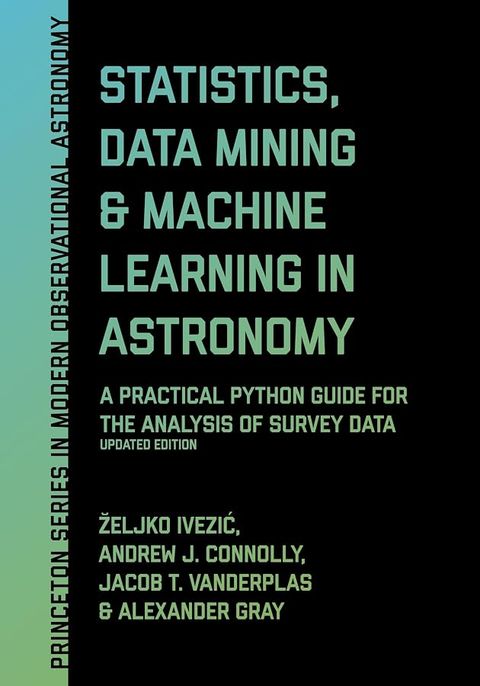
- Statistics, Data Mining, and Machine Learning in Astronomy Željko Ivezić, Andrew J. Connolly, Jacob T. VanderPlas and Alexander Gray
- Linear Algebra and Learning from Data Gilbert Strang
- Causal Inference Scott Cunningham

Sources
As an Amazon Associate, Best AI Books earns from qualifying purchases. Best AI Books is sponsored by Iternal.ai, whose founder and CEO, John Byron Hanby IV, wrote The AI Strategy Blueprint, our #1 ranked book. How we rank books.
