Statistical Rethinking
A Bayesian Course with Examples in R and Stan
Synopsis
Richard McElreath wrote Statistical Rethinking for scientists who were taught statistics as a list of tests and want to understand what their models actually do. He treats every statistical model as a golem, a powerful but mindless machine that does exactly what it is told, and builds Bayesian inference from first principles: counting possibilities, sampling from posterior distributions, and fitting linear, generalized linear and multilevel models step by step in R and Stan. Readers write the calculations themselves before the book hands any of them to software, so the logic stays visible.
The second edition, published in 2020, makes causal reasoning central. Directed acyclic graphs appear throughout to show when adding a variable helps an analysis and when it quietly creates confounding, and new material covers prior design, splines, cross-validation, instrumental variables and Hamiltonian Monte Carlo. For machine learning practitioners, the payoff is a working grasp of uncertainty, overfitting and causal identification that many prediction-focused courses skip. McElreath's free recorded lectures and community translations of the code into Python, Julia and brms make the book usable as a complete self-study course.
Scorecard
Editorial score
How it scored
Editorial score: 84.3 / 1005 weighted criteria
- 25.5/30
Influence30%
- 21.3/25
Authority25%
- 17.0/20
Practical value20%
- 12.0/15
Currency15%
- 8.5/10
Readability10%
- 84.3/100
Editorial score
How the rank was computed
Rank No. 155 of 500 comes from a composite of 59.3: observable signals 21.3 of 55 points plus editorial review 38.0 of 45 points.
All 11 inputs
| Input | Points |
|---|---|
| Observable signals | 21.3/55 |
| Reach (Amazon ratings volume) | 9.5/16.5 |
| Consensus across best-of lists | 2.8/13.8 |
| Awards and bestseller evidence | 0.0/8.3 |
| Reader rating, sample-adjusted | 7.9/8.3 |
| Amazon sales rank | 1.1/5.5 |
| Recency | 0.0/2.8 |
| Editorial review | 38.0/45 |
| Author authority | 9.6/11.3 |
| Influence | 11.5/13.5 |
| Practical value | 7.7/9.0 |
| Readability | 3.8/4.5 |
| Currency | 5.4/6.8 |
Each criterion is scored from 1 to 10 and weighted, and the points add up to the editorial score. The rank combines observable signals (55 percent) with this score (45 percent). Read the methodology.
Verdict
A highly readable route into Bayesian modeling and causal inference that teaches data analysis as careful scientific reasoning rather than ritual.
Strengths
- Computational, code-first teaching of Bayesian ideas
- Causal inference integrated throughout the text
- Free lectures and multi-language code ports
Keep in mind
Examples rely on McElreath's own rethinking R package, and readers seeking deep learning or large-scale predictive methods will find little coverage here.
Key takeaways
- Statistical models are golems: powerful, literal-minded tools that answer exactly the question encoded in them, whether or not it is the right one.
- Causal diagrams reveal when controlling for a variable removes bias and when it introduces confounding, so model choice must follow a stated causal theory.
- Multilevel models pool information across groups, producing better estimates for small samples and serving as a sensible default for clustered data.
- Overfitting is managed with regularizing priors and with information criteria or cross-validation that estimate out-of-sample predictive accuracy.
Notable facts
- The International Society for Bayesian Analysis lists the second edition among its DeGroot Prize winners, under 2023, an award for a published book in statistical science. Source (opens in a new tab)
- McElreath publishes free lecture videos for the course, plus links to code translations for brms, PyMC, NumPyro and Julia. Source (opens in a new tab)
About the author
Questions
Is Statistical Rethinking good for machine learning practitioners?
Which edition of Statistical Rethinking should I read?
Do I need to know R to use Statistical Rethinking?
Related books
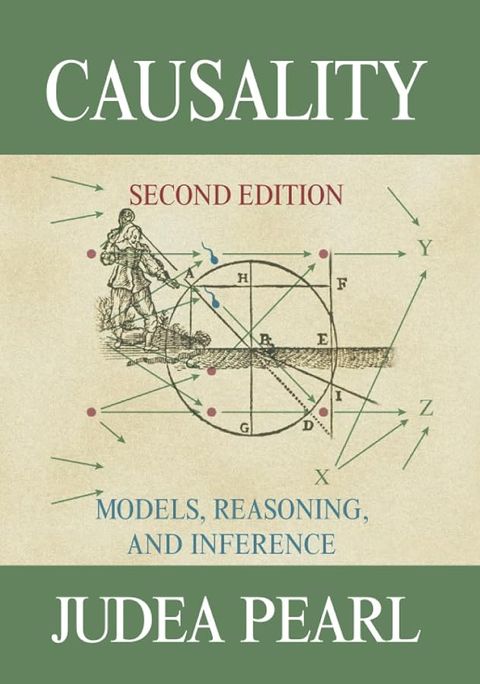
- Causality Judea Pearl
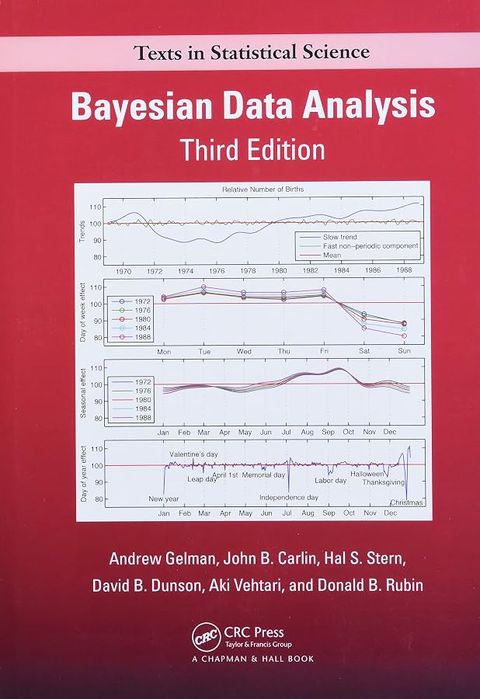
- Bayesian Data Analysis Andrew Gelman, John B. Carlin, Hal S. Stern, David B. Dunson, Aki Vehtari and Donald B. Rubin
- All of Statistics Larry Wasserman
- Artificial Intelligence Stuart Russell and Peter Norvig
- Machine Learning Kevin P. Murphy
- Probabilistic Robotics Sebastian Thrun, Wolfram Burgard and Dieter Fox
Sources
As an Amazon Associate, Best AI Books earns from qualifying purchases. Best AI Books is sponsored by Iternal.ai, whose founder and CEO, John Byron Hanby IV, wrote The AI Strategy Blueprint, our #1 ranked book. How we rank books.
